Unlock trading success! Discover the best technical analysis tools in trading app & empower your investment decisions. Master charts, indicators, and strategies
Unlock trading success! Discover the best technical analysis tools in trading app & empower your investment decisions. Master charts, indicators, and strategies for optimal gains in the Indian stock market.
Best Technical Analysis Tools in Trading App
Introduction: Navigating the Indian Stock Market with Technical Analysis
The Indian stock market, with its vibrant exchanges like the National Stock Exchange (NSE) and the Bombay Stock Exchange (BSE), offers a plethora of opportunities for investors. However, navigating this complex landscape requires more than just intuition. Technical analysis, the art of interpreting market data to forecast future price movements, is a powerful tool for traders of all levels, especially in today’s fast-paced digital world. Trading apps, packed with advanced features, have democratized access to these sophisticated analytical tools. Whether you’re investing in equities, mutual funds (including SIPs and ELSS), or exploring other avenues like PPF or NPS, understanding technical analysis can significantly enhance your investment returns.
The Power of Technical Analysis for Indian Investors
Technical analysis is based on the premise that market prices reflect all available information. By studying historical price and volume data, traders can identify patterns and trends that can help predict future price movements. This is particularly crucial for Indian investors looking to time their entries and exits in the market effectively. Here’s why technical analysis is valuable:
- Identifying Trends: Recognize upward, downward, and sideways trends to capitalize on market momentum.
- Determining Support and Resistance Levels: Pinpoint price levels where buying or selling pressure is expected to be strong.
- Predicting Price Reversals: Spot potential turning points in the market to anticipate changes in direction.
- Managing Risk: Set stop-loss orders and take-profit levels based on technical indicators to protect your capital.
- Improving Trading Discipline: Make data-driven decisions rather than relying on emotions or gut feelings.
Essential Technical Analysis Tools in Trading Apps
Modern trading apps offer a wide array of technical analysis tools, empowering investors to make informed decisions directly from their smartphones or tablets. Here are some of the most essential tools:
1. Chart Types: Visualizing Price Movements
Different chart types provide different perspectives on price action. Understanding these charts is fundamental to technical analysis.
- Line Charts: The simplest type, connecting closing prices over a period. Useful for identifying broad trends.
- Bar Charts: Display the open, high, low, and close prices for each period. Provide more information than line charts.
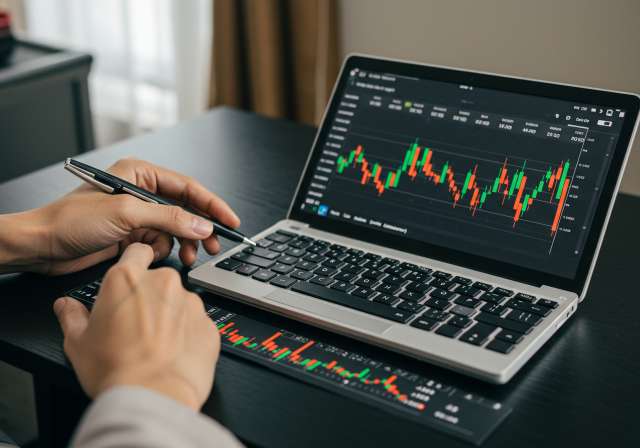
- Candlestick Charts: Similar to bar charts, but use colored “bodies” to represent the difference between the open and close prices. Green or white bodies indicate a higher close than open, while red or black bodies indicate a lower close than open. Candlestick patterns are widely used to identify potential reversals and continuations. Popular patterns include the Doji, Hammer, Engulfing Pattern, and Shooting Star.
- Heikin-Ashi Charts: A modified version of candlestick charts that smooths out price data, making it easier to identify trends.
2. Trendlines: Identifying the Direction of the Market
Trendlines are lines drawn on a chart to connect a series of high or low prices. They help identify the direction of the market.
- Uptrend Lines: Drawn along a series of higher lows, indicating a rising market.
- Downtrend Lines: Drawn along a series of lower highs, indicating a falling market.
- Horizontal Lines: Drawn to represent support and resistance levels.
3. Moving Averages: Smoothing Price Data
Moving averages (MAs) smooth out price data to filter out noise and highlight trends. They are calculated by averaging prices over a specific period.
- Simple Moving Average (SMA): Calculates the average price over a given period.
- Exponential Moving Average (EMA): Gives more weight to recent prices, making it more responsive to changes in the market. Common periods include 50-day, 100-day, and 200-day MAs.
4. Oscillators: Gauging Overbought and Oversold Conditions
Oscillators are indicators that fluctuate between defined levels, helping to identify overbought and oversold conditions in the market. They are particularly useful in range-bound markets.
- Relative Strength Index (RSI): Measures the magnitude of recent price changes to evaluate overbought or oversold conditions. Values above 70 typically indicate overbought conditions, while values below 30 indicate oversold conditions.
- Moving Average Convergence Divergence (MACD): Shows the relationship between two moving averages of a security’s price. It consists of the MACD line, the signal line, and a histogram. Crossovers of the MACD line above or below the signal line can generate buy or sell signals.
- Stochastic Oscillator: Compares a security’s closing price to its price range over a given period. It also identifies overbought and oversold conditions.
5. Volume Indicators: Confirming Price Movements
Volume indicators measure the amount of trading activity. High volume typically confirms price movements, while low volume suggests weakness.
- On Balance Volume (OBV): Accumulates volume on up days and subtracts volume on down days. It helps identify accumulation or distribution phases.
- Accumulation/Distribution Line (A/D): Measures the flow of money into or out of a security. It considers both price and volume.
6. Fibonacci Retracements: Identifying Potential Support and Resistance Levels
Fibonacci retracements are horizontal lines that indicate potential support and resistance levels based on Fibonacci ratios (23.6%, 38.2%, 50%, 61.8%, and 100%). They are drawn by identifying a significant high and low and then dividing the vertical distance by these ratios. Fibonacci extensions can also be used to project potential price targets.
7. Bollinger Bands: Measuring Volatility
Bollinger Bands consist of a moving average and two bands plotted at standard deviations above and below the moving average. They measure volatility and identify potential overbought and oversold conditions. When the price touches the upper band, it may indicate an overbought condition, while touching the lower band may indicate an oversold condition.
Choosing the Right Trading App for Technical Analysis
With numerous trading apps available in India, selecting the right one is crucial for effective technical analysis. Consider these factors when choosing a trading app:
- Comprehensive Charting Tools: Ensure the app offers a variety of chart types, indicators, and drawing tools.
- Real-Time Data: Access to real-time price data is essential for accurate technical analysis.
- Customization Options: The ability to customize charts and indicators to suit your trading style.
- User-Friendly Interface: An intuitive and easy-to-navigate interface.
- Educational Resources: Access to tutorials, articles, and other resources to learn about technical analysis.
- Reliable Customer Support: Prompt and helpful customer support in case you encounter any issues.
Integrating Technical Analysis with Fundamental Analysis
While technical analysis is a powerful tool, it’s essential to remember that it’s just one piece of the puzzle. Combining technical analysis with fundamental analysis can lead to more informed and successful investment decisions. Fundamental analysis involves evaluating a company’s financial health, industry trends, and overall economic conditions. By considering both technical and fundamental factors, investors can gain a more holistic view of the market.
Examples of Using Technical Analysis in Indian Markets
Let’s consider some practical examples of how technical analysis can be applied to the Indian stock market:
- Identifying a Buy Opportunity in Reliance Industries: Suppose you notice that the stock price of Reliance Industries has been consistently forming higher lows on a daily chart, indicating an uptrend. You also observe that the RSI is consistently above 50, suggesting positive momentum. Based on this technical analysis, you might consider initiating a long position (buying the stock).
- Setting a Stop-Loss Order for HDFC Bank: You have purchased shares of HDFC Bank and want to protect your capital. You can use a trailing stop-loss order based on the 20-day EMA. As the stock price rises, the stop-loss order automatically adjusts upwards, locking in profits while limiting potential losses.
- Analyzing Nifty 50 Index: You want to gauge the overall market sentiment. By analyzing the Nifty 50 index chart, you can identify key support and resistance levels. If the index breaks above a major resistance level on high volume, it may signal a bullish market outlook.
Risk Management and Technical Analysis
Risk management is an integral part of trading. Technical analysis provides tools to manage risk effectively.
- Setting Stop-Loss Orders: Use support levels identified through technical analysis to set stop-loss orders.
- Position Sizing: Determine the appropriate position size based on your risk tolerance and the volatility of the asset.
- Diversification: Don’t put all your eggs in one basket. Diversify your portfolio across different sectors and asset classes.
Continuous Learning and Practice
Technical analysis is a skill that requires continuous learning and practice. The market is constantly evolving, and new patterns and strategies emerge. Stay updated with the latest developments in technical analysis, attend webinars and workshops, and practice your skills through paper trading or demo accounts. Many brokers in India offer free demo accounts where you can practice your trading strategies without risking real money.
Conclusion: Empowering Your Trading Journey with Technical Analysis
In conclusion, mastering technical analysis tools available in trading apps can significantly empower your trading journey in the Indian stock market. By understanding chart patterns, indicators, and strategies, you can make more informed investment decisions, manage risk effectively, and ultimately improve your chances of success. Remember to choose a trading app that provides comprehensive charting tools, real-time data, and educational resources. Combine technical analysis with fundamental analysis for a holistic view of the market. And most importantly, never stop learning and practicing. With dedication and discipline, you can unlock the potential of technical analysis and achieve your financial goals in the Indian stock market.